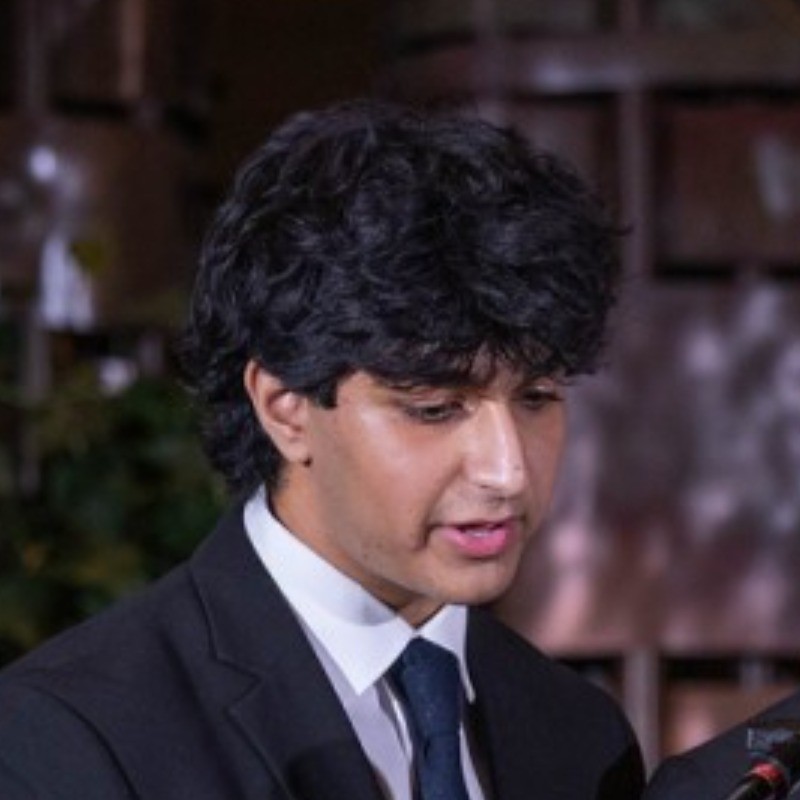
Abhay Gupta ML Engineer & AI Researcher
ML Engineer @ Kita (YC W26) · Research Intern @ Stanford AI Lab
Contact: abhaygupta1266@gmail.com
I build production AI systems and conduct research on large language models, alignment, fairness, and long-context reasoning. I am currently an ML Engineer at Kita (YC W26), where I build AI infrastructure for commercial lending, and a research intern at the Stanford Artificial Intelligence Laboratory (SAIL) working under Prof. Yejin Choi and Liwei Jiang.
My work spans production document intelligence, synthetic alignment data, counterfactual medical AI evaluation, dialect robustness, and multi-hop reasoning. It has appeared at EMNLP, NeurIPS, and AACL venues.
News
- May 2026: Joined Kita (YC W26) as an ML Engineer, building production AI systems for commercial lending.
- Jan 2026: Honored to receive the AI2050 Compute Grant from Schmidt Sciences with 100K hours of NVIDIA H100 compute to advance our research on Pluralistic Alignment.
- Aug 2025: Two papers accepted at EMNLP! NovelHopQA was accepted to EMNLP Main 2025, and EnDive was accepted to Findings of EMNLP 2025, both as lead author.
- Jul 2025: Joined the Stanford Artificial Intelligence Laboratory (SAIL), working under Prof. Yejin Choi and Liwei Jiang.
- Jul 2025: Honored to be a Davidson Fellow ($25,000 scholarship) for my research contributions.
Selected Publications (* indicates equal contribution)

NovelHopQA: Diagnosing Multi-Hop Reasoning Failures in Long Narrative Contexts
In collaboration with Meta and UC Berkeley
Proceedings of the Association for Computational Linguistics: EMNLP 2025
Current LLMs struggle to answer questions spanning tens of thousands of tokens. We introduce NovelHopQA, an innovative benchmark to evaluate 1-4 hop QA over 64k-128k-token excerpts from 83 full-length public domain novels. Our research evaluates six SOTA models, revealing that scale alone does not guarantee robust multi-hop reasoning.

EnDive: A Cross-Dialect Benchmark for Fairness and Performance in Large Language Models
Findings of the Association for Computational Linguistics: EMNLP 2025
EnDive (English Diversity) addresses the lack of intra-language evaluation in standard benchmarks. Translating SAE datasets into five underrepresented dialects via few-shot prompting, we created a challenging diagnostic that uncovers persistent model biases against non-standard language speakers across reasoning, logic, and math tasks.
AAVENUE: Detecting LLM Biases on NLU Tasks in AAVE via a Novel Benchmark
Proceedings of the Third Workshop on NLP for Positive Impact, 2024
To develop more inclusive NLP systems, we introduced AAVENUE, a benchmark to evaluate LLMs on NLU tasks in African American Vernacular English (AAVE). The benchmark uses human-verified LLM translation to reliably map GLUE and SuperGLUE metrics out to AAVE.
MEDEQUALQA: Evaluating Biases in LLMs with Counterfactual Reasoning
Proceedings of SciProdLLM, IJCNLP-AACL 2025
Evaluates how demographic cues influence clinical reasoning in frontier LLMs by holding critical symptoms constant while perturbing patient pronouns in 69,000 parallel test items, exposing localized divergences in downstream medical rationales.
CivicParse: A Benchmark and Pipeline for Structured Online Deliberation
Accepted @ NeurIPS 2025 LLM Evaluation Workshop
Introducing a two-stage NLP extraction and classification pipeline to structure raw, free-form online discussions into a coherent deliberation map of core issues, barriers, and solutions. Outperforms prompt-only baselines and establishes a standardized task for modeling collective civic intelligence.
Experience
Industry & Startups
Kita (YC W26)
ML Engineer
May 2026 - Present · Remote
- Building an end-to-end loan origination platform that classifies borrower documents, extracts financial data, and generates cited credit memos in real time.
- Led development of a production document risk-scoring API for a top 10 microlender internationally, converting approximately 590 extracted signals into 10 underwriting risk indices and validating the system against a 50,000-document corpus.
- Supporting production deployment across multiple international markets serving millions of borrowers; also built multi-tenant borrower portals, authentication and lender workflows, and external underwriting APIs using FastAPI, Gemini, PlanetScale, S3, and Auth.js.

Cluely
ML Intern
Aug 2025 - Oct 2025 · Remote
- Built production LLM systems for enterprise customers, designing custom AI assistants and prompt pipelines tailored to customer workflows and brand voice.
- Developed a CLI-based LLM evaluation framework for prompt benchmarking and regression testing, improving pipeline accuracy and iteration speed by approximately 40%.
- Collaborated directly with enterprise customers to design, deploy, and iterate AI solutions across real-world business workflows.

Mathos AI
ML Intern (YC W24)
May 2025 - Jul 2025 · Remote
- Built AI-powered quiz and flashcard generation tools used by more than 1 million students, developing LLM pipelines for automated educational content creation and retrieval.
- Improved content quality through prompt engineering, evaluation, and iterative testing while optimizing latency and scalability for production deployment.
Research

Stanford Artificial Intelligence Laboratory (SAIL)
Research Intern
Jul 2025 - Present · Remote
- Developing PluralisticDataSmith under Prof. Yejin Choi: an open-source agentic framework for generating synthetic alignment data across diverse value systems.
- Built the constitutional data-generation pipeline, filtering 243 value specifications and synthesizing a 1.2-million-example training corpus through model ensembling and iterative critique and refinement.
- Designed a retrieval-augmented benchmark validated by 324 human annotators across more than 5,800 judgments; LoRA fine-tuning improved strict alignment pass rates by up to 14 percentage points. The work is supported by Schmidt Sciences' AI2050 program with 100,000 H100 GPU hours.

Harvard-MIT Health Sciences and Technology (HST)
Research Intern
Nov 2024 - Oct 2025 · Remote
- Led MedEqualQA, a 69,000-example counterfactual benchmark evaluating reasoning stability and demographic robustness in medical LLMs.
- Built large-scale data-generation and evaluation pipelines using minimally perturbed clinical narratives to isolate demographic variation and uncover hidden reasoning instabilities in frontier models.

Massachusetts Institute of Technology (MIT CCI Lab)
Research Intern
Nov 2024 - Dec 2025 · Remote
- Collaborating with Prof. Mark Klein at the MIT Center for Collective Intelligence.
- First author on CivicParse, an NLP extraction and classification pipeline bridging argumentation theory and AI to map large-scale deliberative discussions.

Algoverse
LLM Researcher
Dec 2023 - Aug 2025 · Remote
- Developed AAVENUE, EnDive, and NovelHopQA, benchmarks for evaluating fairness, dialect robustness, and long-context reasoning in large language models.
- Built evaluation pipelines spanning five English dialects and 64k-128k-token multi-hop reasoning tasks, uncovering systematic failures in frontier LLMs.
- Research was accepted to EMNLP 2025 Main, EMNLP 2025 Findings, and EMNLP NLP4PI 2024 and has collectively received 43 citations from researchers at leading universities and industry labs.
Education
John Jay Senior High School
Hopewell Junction, New York · Graduated June 2026
SAT: 1550 (790 Math; 760 Reading & Writing)
Grants & Fellowships
AI2050 Compute Grant (100K hours of NVIDIA H100 compute)
Schmidt Sciences (Jan 2026)
Davidson Fellow Scholarship ($25,000)
Davidson Institute (Jul 2025)
Personal
My journey in AI began with a simple curiosity about how machines process human language, but it was Kevin Zhu who truly opened the door to the world of research for me. He was the very first person to guide my early steps, teaching me through everything and becoming my most impactful mentor. That initial curiosity quickly evolved into a passion for ensuring these systems are fair, inclusive, and safe for everyone. As I continue to grow, I am also incredibly grateful to Prof. Yejin Choi and Liwei Jiang for continuously inspiring me to tackle the difficult sociotechnical problems in AI alignment.
Outside of running evaluations and writing papers, I enjoy exploring the intersection of technology and linguistics, keeping up with the rapid pace of open-source AI, and finding new ways to make complex machine learning concepts accessible to my peers.